Finished 08/08/2026
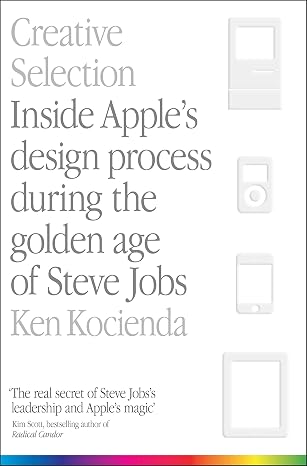
Creative Selection
Recommended by my CEO, very useful for understanding the creative process behind the iPhone keyboard.
Great book. An experienced engineer explains technical details clearly and lays out the creative process at Apple, always based on demos, demos, demos and iteration, testing prototypes. You can see how it permeated and inspired many companies, including some I have worked at. What a story! I am glad the final version, with an auto-correction algorithm, is the one that shipped. Exceptionally talented people. I recommend it. You see how a creative team operates, and it is very inspiring.
Notes
- 🔑 Goal is to explain how they work at Apple, with 7 essential elements of its success:
- Inspiration: think big and imagine possibilities
- Collaboration: work together with others and combine skills
- Craft: apply your skills to reach high-quality goals
- Diligence: do the necessary work, no shortcuts or half measures
- Decisiveness: make tough calls and do not delay or procrastinate
- Taste: have good taste and find the balance between pleasant and functional
- Empathy: look at the world through other people’s perspectives
- Demos are the central tool: that is how an idea becomes software. Demos make people react, and feedback on a demo pushes you to make the next one.
- A demo must be choreographed: it should be convincing for exploring the idea, not be the product. Be clear on what to include and what to leave out; what only provides context should be done at the right level of detail, not more.
- Richard did not worry that his browser demo did not integrate well with the Mac (menu bar, font rendering, KDE stuff irrelevant to browsing): he knew the technical details would be sorted out later, and doubts about shortcuts fade as soon as the viewer goes back to browsing.
- Making demos is hard: you have to invest time in an idea you are not sure about and expose it to colleagues who will critique without hesitation. Almost all demos fail, and knowing that makes it hard even to start one.
- 🔑 Dogfooding: the team updated the keyboard software on Wallaby prototypes every day and actually used it.
- The “eff grackles” demo shows how much good data matters.
- Demo reviews with Steve: he asked where to look and who you were, and you used the minimum number of words to direct his attention. Then he looked closely and asked brief questions to see whether the work could be simplified.
- The push for simplicity had a purpose: he put himself in the shoes of customers who do not care about the software industry, and he did not want to overload people who already have their lives to manage.
- After the verdict, no one argued, not because Steve was closed off, but because objecting meant asking to put complexity back in. People in those meetings knew when to stay quiet.
- “We only need one of these, right?” - the on-the-spot decision to cut.
- When Scott asked to cut the suggestion bar after a year of work, it was not a problem: lightening the software improves the experience.
- Craft in the details: Bas’s zoom-key animation started slowly and accelerated, and it looked like a complex morph from one keyboard to another. It was not; the design was simple and the code took a couple of hours to write. The magic was in the overall effect: not a slide change, but one keyboard becoming the other.
- Taste and QWERTY: QWERTY is cultural heritage; people know it. Richard would pick up the Wallaby and type without thinking, decades of muscle memory. Familiarity beats theoretical optimization.
- Beauty as “pleasant to the eye” only goes so far. “Design is how it works” (Jobs)
- On taste, Kant is worth studying, but philosophical discussion is the wrong tool when you need practical decisions. Like a carpenter pondering materials science before choosing a hammer. Better to see yourself as a carpenter than a philosopher, and stay focused on application
- Heuristics for the liberal-arts-leaning aspects, algorithms for the technical side: two sides of the same coin, same mechanism (input, operation, output), different purposes
- Diligence and priorities: Knuth, programmers waste huge time worrying about the speed of noncritical parts, and these efficiency attempts weigh on debugging and maintenance. You can ignore small optimizations 97% of the time.
- People matter more than code: if Scott had not found the right words after the management change on Safari, Kocienda would have gone to Google and the WebKit editing project would never have started. If pride had kept him from listening to advice from Darin and Trey, he would have stayed stuck.
- Excellence in any field is in closing the gap between accidental and intentional: not getting something or everything, but one specific, well-chosen thing. Turn words into a vision and use the vision to set actions that produce results.
- Final advice for beginners: put in the work. Decide what doing a good job means and try to make it happen. Success is not guaranteed and the effort is real, but if you like what you do it will not feel so hard